
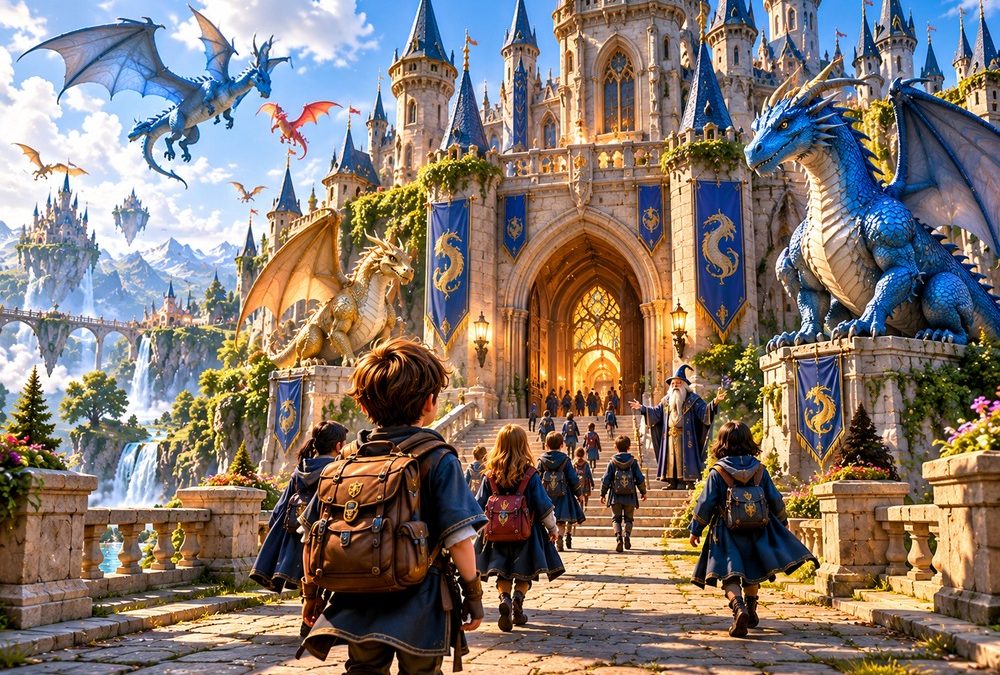
A fantasy setting may feature floating buildings, hidden valleys or schools attended by dragons, yet some of its most interesting details can remind children of real places. A description of a courtyard might lead to questions about castles; an imagined market might prompt curiosity about how people trade; a mountain path might make a reader wonder about landscapes and travel. Fiction can provide the spark while real-world investigation supplies a different kind of discovery.
Look for the familiar inside the fantastic
Writers often give extraordinary places ordinary features so readers can picture them: doors, paths, rooms, rivers, weather and communities. Ask children to choose one detail from a passage and identify something similar in the world they know. A fictional school may have a grand entrance or a particular set of rules, but the child can still recognise the feeling of arriving somewhere unfamiliar. This connection does not prove that the author based the setting on a particular real location. It is simply a way to use language from the story as the beginning of curiosity.
Turn description into a question
Suppose an adventure describes a tower with a narrow staircase. A child might ask why some real towers used spiral stairs, how stone buildings stay upright or how people lived in castles. Record the question before searching for an answer so the investigation has a purpose. Children’s questions do not always fit neatly into school subjects; one passage may lead towards history, geography, architecture or wildlife. Encourage them to find a reliable source and notice where evidence is available. Do not present a fantasy author’s invented structures as evidence about medieval engineering.
Use maps without confusing fiction and geography
Drawing a map of an imaginary place helps readers think about routes, distance and landmarks. Place a compass direction on the drawing or decide where a traveller would encounter a river. Then compare it with a real map, perhaps of the local area or a public park. What features do both maps need? What extra symbols help explain a real route? The activity is a comparison, not an attempt to locate Dragamas School on an actual map. Fantasy geography can be playful while still encouraging the practical habit of looking closely at spatial information.
Explore architecture through images
A child fascinated by imagined castles may enjoy photographs of real fortifications, towers or cathedrals. Ask how people entered, moved through and used those buildings. Notice windows, steps, walls and open spaces. Discuss why a fictional artist or writer might exaggerate height, colour or scale to create a magical atmosphere. Avoid assuming every fantasy castle copies a European design; real buildings reflect many cultures and purposes. A local library book or museum website may provide a better explanation of a real structure than a random picture without context.
Example: a dragon-school courtyard
After reading a description of an extraordinary school, children design an imagined courtyard where dragons and pupils could safely meet. They draw entrances, waiting spaces and places for different activities. The teacher then shows a photograph of a real school courtyard and asks what practical needs it serves. Shade, shelter, movement and safety become part of the conversation. None of the invented courtyard details are presented as features of Sammy Rambles. The children are using a fictional premise to investigate how real spaces are planned and why design choices matter.
Connect landscape with living things
A fictional forest may inspire questions about real habitats. What plants grow in local woodland? Which creatures rely on trees, dead wood or ponds? A fantastical animal may be invented, but a real ecosystem has relationships that can be observed and researched. Invite a child to describe what would be different if a dragon lived there, clearly labelling this as an imaginative extension. The contrast helps them distinguish between factual observations and creative possibilities. A walk in a safe public place or a visit to a nature centre can provide a concrete follow-up.
Make research manageable
Choose one question rather than launching a project that becomes a second homework assignment. Find two dependable sources — perhaps a library book and a museum or public information website — and compare what they say. Encourage children to record the answer in their own words, using a sketch or a short oral explanation if writing is difficult. Ask where the information came from. Curiosity is strengthened by discovering how to check a claim, not merely by collecting exciting pictures. Recognise when a question remains unanswered rather than filling the gap with a guess.
Bring the discoveries back to reading
After learning about a real place, return to the fantasy scene and ask what the author changed. Is the fictional building impossibly tall? Does the landscape contain creatures absent from the real world? Which sensory details make it convincing? These observations can deepen enjoyment without reducing every magical element to a factual explanation. Fantasy is allowed to be impossible; research simply offers fresh ways of noticing an author’s choices. Children may also be inspired to write a new setting using one accurate real detail and one clearly invented feature.
Where Sammy Rambles fits
Dragamas School for Dragon Charming is a confirmed part of the Sammy Rambles world. Its existence invites imaginative questions about buildings and school life, but an article should not invent its layout or claim that it is modelled on a particular castle. Read the official free chapter to discover what the author actually describes. A family can then choose a real-world question arising from the scene and explore it separately. The reward is a richer conversation about both stories and places, without confusing fiction with factual geography.
Visiting a real place with a story question
A visit to a local museum, historic building or public garden can become more interesting when a child arrives with one question prompted by fiction. Before setting off, agree on what to look for: perhaps a staircase, a defensive wall or a garden laid out in formal paths. Read any display information carefully and ask staff where to find trustworthy details. If the child’s invented fantasy version includes dragons, keep that as a separate imaginative discussion. Afterwards, compare one fact learned on the visit with one detail from a book. The result need not be an essay; a short conversation or labelled sketch can capture both curiosity and evidence.