
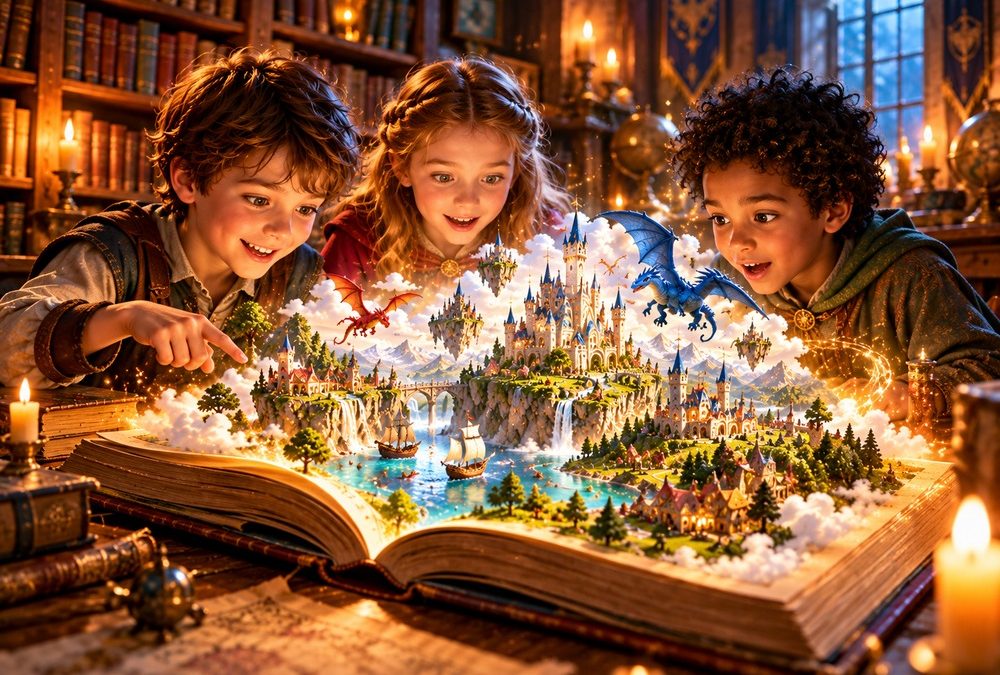
A story can include a character thinking about the past without actually leaving the present scene. That is different from a full flashback. Distinguishing memory, imagination and current action helps young readers understand which events are taking place in the story and which exist in a character’s thoughts.
Begin with the character’s physical location
Imagine a character standing beside a locked gate while remembering a conversation with a parent. The gate and the standing character belong to the current action; the conversation belongs to the past. Ask where the character’s body is during the passage. If they are still standing at the gate, the writer may be showing a thought rather than moving the narrative into a separate scene. Words such as “remembered”, “wondered” and “pictured” can help, although writers do not always use them. A clear physical anchor is often the easiest clue for a child who struggles to follow changes in time.
Notice the language of remembering
A memory may be introduced with “he recalled”, “she could still hear” or “it reminded them of”. These phrases connect something happening now with something that happened before. The remembered material can be only one sentence, such as the exact words of an earlier warning. Read around the memory to see what prompted it. An old photograph, unfamiliar smell or spoken name might be the trigger. Ask why this recollection matters at this particular moment. It may influence a decision, reveal a fear or show what a relationship once meant to the character.
Separate imagined possibilities
A character might also picture something that has never happened: a dragon flying over their home, a friend winning a contest or a secret door opening. This is imagination, not memory. Readers can be tempted to repeat an imagined scene as if it were an established event. A useful question is, “Has the narrator told us this happened, or is the character wondering what might happen?” Look for phrases such as “if only”, “perhaps” and “he imagined”. The difference is especially important when discussing fantasy, where genuinely magical events coexist with very ordinary daydreams.
Think about dreams as a separate category
Dream sequences can resemble actual scenes because they contain dialogue, places and action. They may use the same vivid descriptions as the rest of the book. The clue often comes at the beginning or end, when the character falls asleep, wakes suddenly or realises the event was impossible. Rather than guessing from how strange a passage sounds, use the narrative evidence. In a fantasy novel, an impossible sight may truly occur within the world of the story. Calling it “just a dream” without textual support risks missing a key event.
Use a simple three-colour system
On a copy of a short passage that you have permission to mark, highlight current action in one colour, remembered events in another and imagined possibilities in a third. If you are reading a library book, use sticky notes or write three short descriptions on separate cards. Children can place a card beside each paragraph and explain the clue that informed their choice. This makes discussion more practical than demanding definitions. It also allows honest uncertainty: “I think this is a memory, but the book hasn’t confirmed it yet” is a strong observation, not an incorrect answer.
Why the distinction changes interpretation
Suppose a character remembers a promise while standing at a crossroads. The memory may explain why they choose the harder road, but it does not mean they made the promise again that day. Likewise, imagining a successful rescue does not mean the rescue has taken place. Confusing these levels can distort a summary of the plot. Ask children to retell the current sequence first, then add what the character remembered or hoped for. Their account will become clearer because each type of information has its own place.
A detail worth noticing
A useful final check is to ask a child to retell the passage in chronological order. They can start with the oldest confirmed event, move to the action happening now, and finally describe any possibility the character imagines for the future. If a detail will not fit neatly, leave it marked as uncertain rather than inventing a date. The result should be a clearer account of the scene, not an obligation to classify every sentence in the novel.
Practise with a two-paragraph story
Write an invented scene in which a traveller hears a bell and remembers hearing the same bell at school. Add one sentence in which the traveller imagines finding a friend at the next station. Now ask a child to underline the event happening now, circle the memory and put a star beside the imagined reunion. They can then write a one-sentence summary that includes only what has happened. While enjoying the Sammy Rambles adventures, the same habit can help distinguish confirmed events from a character’s thoughts without spoiling the pleasure of discovery.