
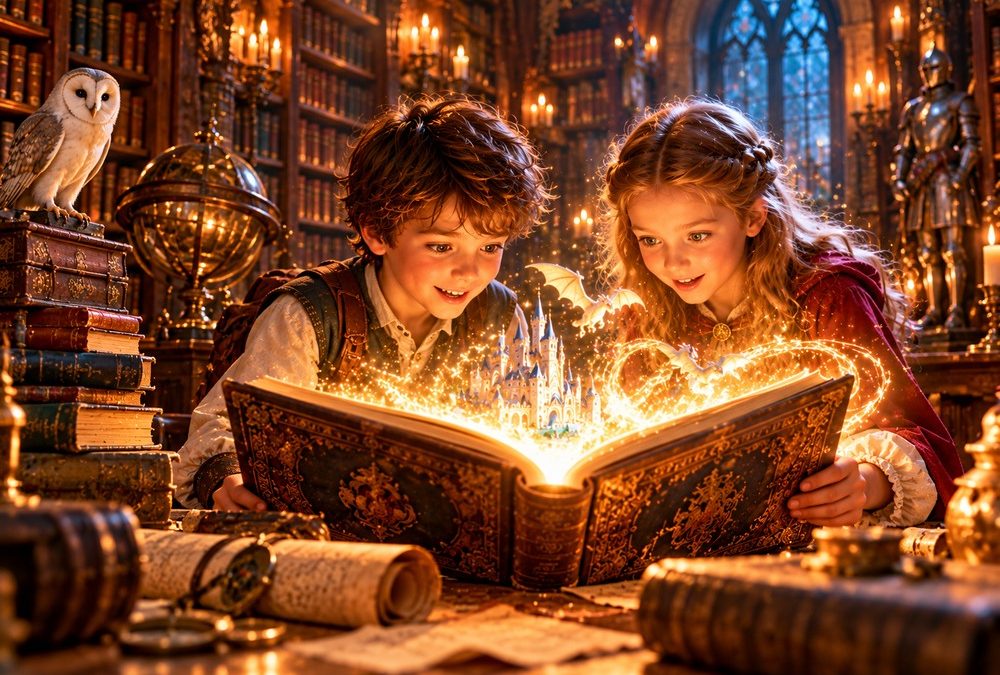
Illustrations offer clues about a story, but they should not replace the words when readers are asked to explain what the text establishes. An image may show a character's surroundings, suggest an atmosphere or invite curiosity about something not yet explained. The useful skill is to look closely, describe what is actually visible and compare that with the written passage. This keeps pictures valuable without encouraging children to treat every imagined detail as a fact.
Describe before interpreting
Ask the child what they can see: colours, objects, people, positions and expressions. Encourage specific observations such as 'There are two figures beside the doorway' rather than jumping straight to 'They are about to escape.' The first statement concerns visible detail; the second is an interpretation. Both can contribute to a discussion, but they should be distinguished. A child who learns to notice the difference becomes more careful about how evidence supports an idea. This habit applies to diagrams and photographs as well as story illustrations.
Compare image and text
Read the paragraph associated with an illustration and ask which details appear in both. Does the writer mention a storm that the picture also shows? Does the text describe something outside the frame? An illustration may emphasise one moment while a paragraph covers a longer period. Children can enjoy finding these differences without deciding that one source must be wrong. Ask what information the words supply that the picture cannot convey, such as a character's private thought or a promise made earlier.
Do not use the picture to guess printed words
Pictures can help readers understand a scene, but beginners should not be encouraged to substitute a plausible word for an unfamiliar printed one. Word reading requires attention to letters and their sounds. If the text says 'horse', saying 'pony' because the image looks like one is not an accurate reading of the word. Help the child decode it, then discuss the scene. This separates the process of recognising words from interpreting images and protects both skills from confusion.
Look for deliberate mood
An illustrator may use light, shadows, distance or colour to create a feeling. Ask how those choices affect the reader's expectations. A narrow doorway framed in darkness may feel mysterious even if nothing dangerous has yet happened. Make clear that atmosphere does not prove an event will occur. Compare the impression with the text: does the author confirm the danger, or is the image creating suspense? This opens an interesting discussion about how pictures and prose work together without treating a visual mood as a hidden plot revelation.
Recognise artistic interpretation
A cover illustration is often designed to represent a book's themes or attract attention rather than reproduce a scene with exact documentary accuracy. A dragon above a castle does not prove that this combination occurs at a particular moment in the story. Ask which elements are confirmed by the published description and which are artistic choices. That distinction matters when discussing Sammy Rambles imagery: readers can enjoy a fantasy illustration without claiming that every visible detail appears in J T Scott's chapters.
Use illustrations to support memory
After reading, invite the child to select a picture that reminds them of an important part of the chapter. Ask what happened around that moment and which sentence supports their explanation. A picture can serve as a memory cue without becoming the entire answer. This may be particularly useful when a child finds open-ended oral questions difficult. If the book has no illustrations inside, a simple drawing made afterwards can serve a similar role, provided invented additions are clearly recognised as the child's interpretation.
Think about what is missing
An image shows one view. Ask what the reader cannot tell from that view alone: what a character has heard, what happened earlier, or what exists beyond the edge. This encourages questions rather than unsupported certainty. Children may suggest several possibilities. Invite them to read further for answers rather than settling on the most colourful guess. Recognising the limits of evidence is as important as noticing clues. It teaches thoughtful uncertainty while keeping curiosity alive.
Create a caption carefully
Ask the reader to write a one-sentence caption that describes the illustration. Then invite a second caption expressing an interpretation: 'The travellers may be worried.' Compare the two. Which could be checked just by looking? Which would need support from the written story? This short exercise helps children see how language changes when a claim is certain or tentative. It can be done aloud if writing feels laborious and does not require a long worksheet.
Try a paired-evidence activity
Choose an illustrated page and divide a sheet into two halves. On one side, write two things that can be seen in the picture. On the other, note two things the written paragraph explicitly tells us. A sentence might appear in both halves if both sources genuinely provide it. Then identify something neither source confirms. The exercise is not a competition between pictures and print. It shows that each communicates differently and that an attentive reader considers both without exaggerating their evidence.
For instance, a drawing may show a traveller beside a castle, while the words explain why the traveller has stopped. The image helps the child visualise the setting, but the motivation comes from the text. Conversely, the illustration might depict weather or architecture not discussed in the paragraph. Ask whether those are confirmed story details or artistic elaborations. Respect the difference, especially when describing another author's published world.
Finally, invite the child to create an illustration from a paragraph and compare it with the book's picture if one exists. Two thoughtful readers might visualise the same words differently. That is part of the imaginative pleasure of literature. The important distinction is between using the text as a starting point and claiming that one's drawing contains only facts explicitly established by the writer.
Enjoy the artwork on its own terms
Sometimes a child simply wants to explore the details of a beautiful fantasy image. That pleasure matters. They can discuss the illustrator's choices, imagine what lies beyond the scene or draw their own version. Just keep imaginative additions separate from factual descriptions of the book. When illustrations and prose are each valued for what they contribute, children learn to pay attention to both. The result is richer reading, not a competition to decide whether words or pictures supply the 'real' story.