
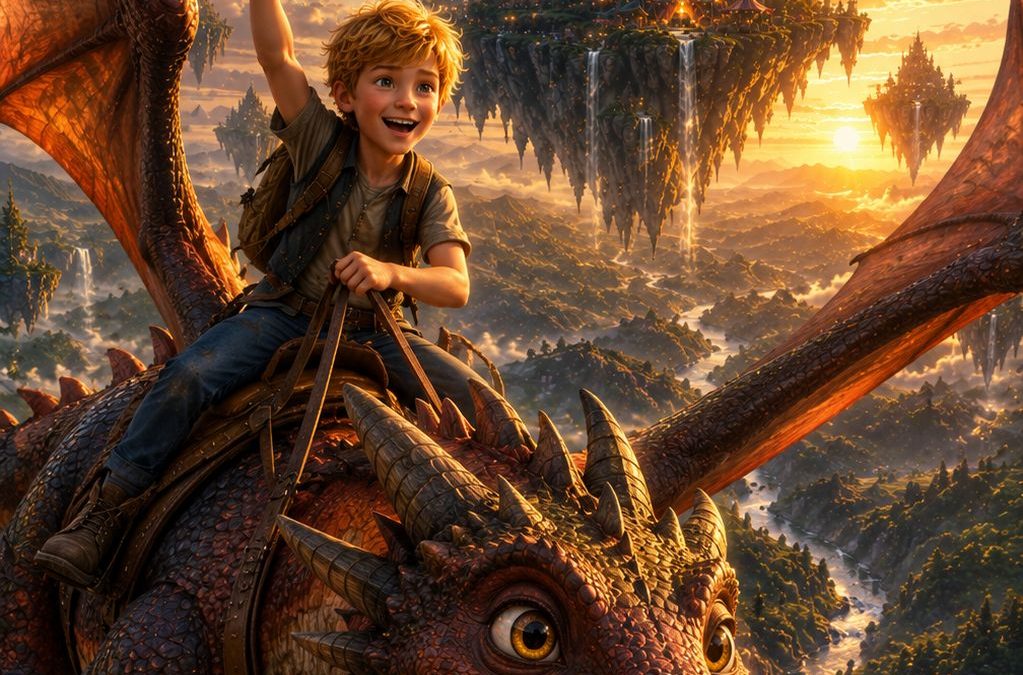
An imaginary creature gives writers a way to introduce a perspective unlike the human characters’. A dragon, forest guardian or talking animal may notice different things, have different needs or misunderstand ordinary customs. Children can use these possibilities to discuss viewpoints, but they should distinguish between traits shown in a particular book and ideas they invent for a separate activity.
Begin with differences you can observe
A creature’s size, movement or senses may affect how it experiences a setting. Imagine entering a narrow room if you have enormous wings, or trying to understand a whispered conversation if your hearing works differently. These questions do not require the creature to be assigned a particular personality. They simply change the conditions of the scene. Ask children which differences come from a published description and which have been invented. Good discussion begins with evidence where it exists and clearly marks speculation where it does not.
Avoid assuming appearance determines character
Fantasy often uses frightening appearances to create tension, but a creature that looks intimidating need not be cruel. Likewise, a beautiful creature is not automatically trustworthy. Invite readers to notice actions, not merely scales, teeth or colour. What did the character actually do? How did others respond, and could those responses have been mistaken? This can open a discussion about first impressions without claiming that a children’s novel teaches a single moral lesson. Allow the text to support the interpretation rather than attaching a message regardless of what the writer shows.
Change the narrator
Choose an invented scene in which a young person meets a large creature beside a river. Write two versions: one from the child’s viewpoint and one from the creature’s. The child may be worried about danger; the creature may be trying to protect its home. Keep the underlying events the same while changing what each narrator knows. Children can tell the story aloud if writing is difficult. The exercise demonstrates why narration matters and why readers should not assume that the first voice they hear knows everything. This is an invented writing task, not a scene from Sammy Rambles.
Consider competing needs
Different viewpoints become interesting when characters want incompatible but understandable things. A dragon may need a safe nesting place while villagers want access to a path. Ask whether a solution could acknowledge both needs. Children might propose a different route, a protected area or an agreement about when the path can be used. The important part is explaining how the proposal affects each character. A solution that sounds good to the humans may still cause trouble for the creature. Such questions support more thoughtful fictional problem-solving than simply choosing a winner.
Use dialogue to reveal misunderstandings
A short conversation can show two characters interpreting the same event differently. One may think a gesture means welcome; the other may see a warning. Encourage children to write or improvise a scene where neither speaker is deliberately dishonest. Afterwards, ask what each character believed and what information could resolve the confusion. This makes viewpoint tangible through words and actions. Avoid inventing complicated magical languages unless that genuinely interests the group; an ordinary misunderstanding provides enough material for a lively exercise.
Example: the library dragon
Imagine that a tiny dragon lives in a library and keeps moving bookmarks because it believes loose paper is nesting material. A librarian thinks somebody is playing tricks, while a child notices the creature collecting colourful strips. Ask the group to describe the problem from all three perspectives. The activity can end with a practical, funny compromise such as supplying safe spare paper. It is a self-contained creative scenario, not a claim about Kyrillan’s habits. Its value is that everyone has a reason for acting as they do, even when those reasons conflict.
Return to the actual characters
If reading Sammy Rambles, children can look at what the published chapters genuinely show about Sammy’s dragon Kyrillan. What does Sammy know, and what is left uncertain? Does the narrator offer insight into more than one perspective? Those questions must be answered from the book, not from an article inventing a dragon psychology. A free sample is available for readers who want to begin with the real text. Discussion can explore what the author reveals and what readers imagine, with the two kept distinct.
Adapt for different ages and interests
Younger readers may prefer choosing facial expressions, drawing two speech bubbles or acting out a misunderstanding. Older readers can compare a first-person account with a third-person narrator, considering how each controls information. A child who struggles to decode text may still explain a sophisticated perspective after listening to a scene read aloud. Offer the same interesting question through different forms of response. The aim is access to imaginative thinking rather than rewarding the pupil who writes the longest answer.
Why the exercise stays with readers
Changing viewpoint can transform a simple conflict into a richer story. Children may discover that the ‘monster’ is guarding something, or that a heroic character has overlooked somebody else’s needs. Not every tale has to end with agreement, and different interpretations can remain reasonable. Encourage readers to support ideas with actions and details rather than stereotypes about creatures. A fantastical setting lets children test those possibilities at a safe imaginative distance while still enjoying mystery, humour and adventure.
Make a viewpoint chart from evidence
Divide a page into three columns: what the human character sees, what the creature might see and what the story actually confirms. Start with a single meeting scene. Children can place exact details in the confirmed column and mark invented possibilities clearly in the other two. For example, a human may notice claws and feel worried; the creature might notice a loud voice and feel uncertain. Neither imagined feeling becomes a published fact without support from the text. Comparing the columns shows how misunderstanding can arise from limited knowledge. The chart can become a short scene with dialogue, but children should keep the creative continuation distinct from any quotation or summary of the original book.
Keep invented creatures consistent
If children invent a creature’s viewpoint, ask them to choose two abilities and one limitation before writing the scene. Perhaps it sees well in darkness but dislikes sudden noise. How would those features affect what it notices at a crowded market? They should avoid changing the creature’s abilities whenever the plot becomes inconvenient. Consistency gives the reader a reason to trust the fictional world and makes later misunderstandings more believable. The invention can remain entirely separate from published dragon characters.